
Published: December 24, 2025 | Updated: 2 October 2026 | Reading time: 9 min | By: azimutbet.net editorial team
Pharaohs, Olympian gods and Norse runes are some of the most common slot themes. They make a game look and sound distinctive, but they do not decide how much it pays. This article separates the story from the maths: how a slot actually produces its results, which numbers in the info panel matter, why popular myths about “hot” machines are wrong, and what Azimutbet (azimutbet.com) publishes about its slots, as checked on 2 October 2026. azimutbet.net is an independent information site, not the operator. Gambling is for adults (18+) and is paid entertainment, not a way to make money.
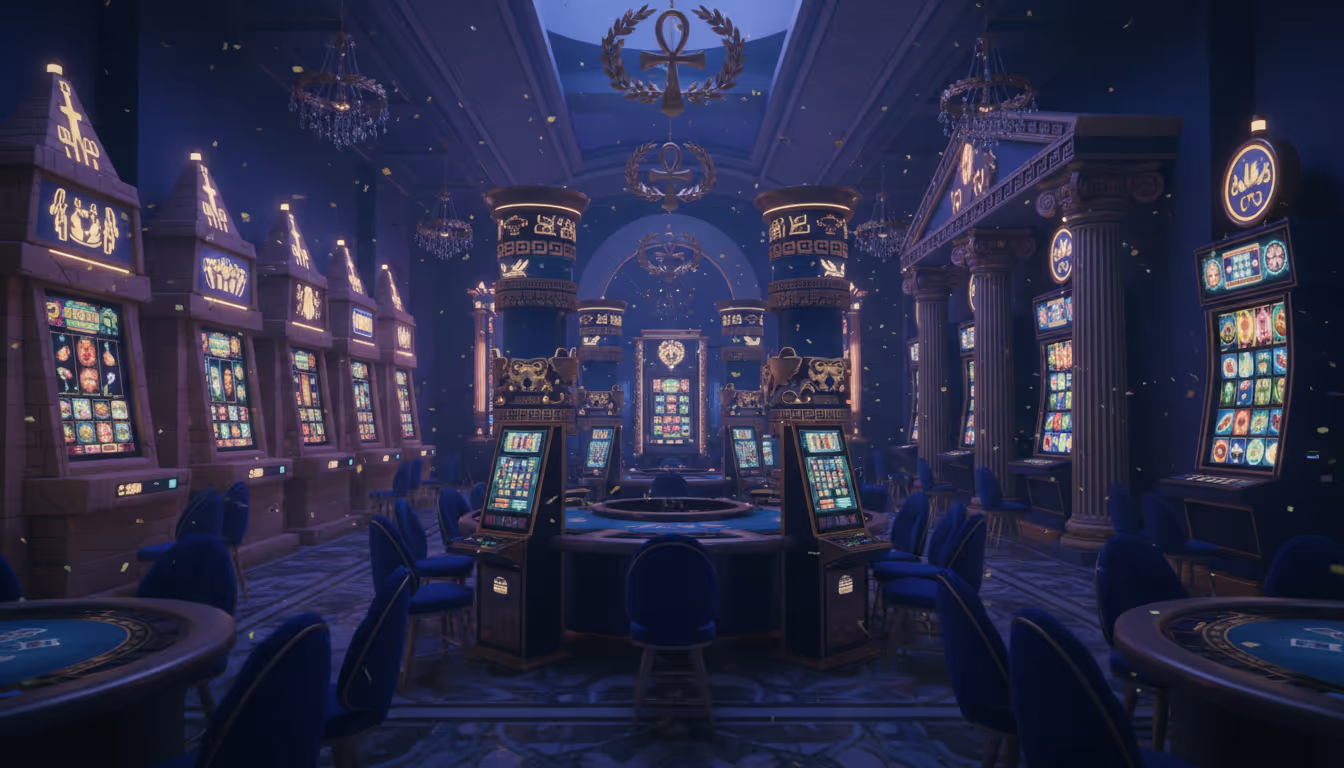
What the theme does – and what it doesn't
Ancient themes tend to come with recognisable mechanics. Many Egyptian games use the “book” mechanic popularised by Novomatic's Book of Ra and Play'n GO's Book of Dead: one symbol acts as both wild and scatter, and during free spins a randomly chosen symbol expands to cover whole reels. Greek-themed games often have a god character who drops multiplier symbols, and Norse games frequently use cascades, where winning symbols disappear and new ones fall into place, sometimes with a multiplier that grows during the feature.
None of this follows from the mythology. The same book mechanic appears in games about explorers and treasure hunters, and cascades are common in fruit and sweets games. What decides the payouts is the game's maths model – the paytable, the reel set-up, how often features trigger and how much they pay on average – which the provider designs and has tested. The artwork is a skin over that model: two games with identical maths and different themes return exactly the same over the long run.
The numbers that decide outcomes
Each spin is decided by a random number generator (RNG) at the moment the spin starts. The result does not depend on earlier spins, and the reel animation simply shows an outcome that has already been determined. Everything else is described by a handful of figures, most of which a game lists in its rules or info panel:
| Term | What it means | What it does not tell you |
|---|---|---|
| RTP (return to player) | The share of all stakes a game is designed to pay back as wins over millions of spins, e.g. 96%. The house edge is 100% minus the RTP. | What you will get back in one session. |
| Volatility | How wins are spread: low volatility means frequent small wins, high volatility means long dry spells and rare large wins. | It does not change the RTP – two 96% games can behave very differently. |
| Hit frequency | The share of spins that return any win, e.g. roughly one spin in four. | Many of those “wins” pay less than the stake. |
| Maximum win | The cap on what one spin or feature can pay, usually given as a multiple of the stake (e.g. 5,000x). | How likely it is – most players never reach it. |
| Bonus buy | A fixed price, often around 100x the stake, to go straight into the feature. Some regulated markets restrict or ban it. | It does not remove the house edge; it only makes results swing more. |
How to read a game's info panel
Open the menu or “i” button inside the game and look for the rules or paytable section. Useful entries are the theoretical RTP (sometimes called “return to player” or “expected payback”), a volatility rating (some providers show it on a scale of one to five), the maximum win and – where a bonus buy exists – its separate RTP. If the panel shows no RTP at all, treat that as missing information rather than a good sign.
Why the same game can exist in several RTP versions
Many large providers supply one title with several certified RTP settings, and each casino chooses which one it runs. The artwork, features and maximum win look identical; only the long-run return differs. That is why an RTP quoted in a provider's marketing material or on a review site may not match the version at a particular casino. The figure that counts is the one shown in the info panel of the game you are actually about to play.
Worked example: what RTP means in money
Assumptions for this example: €1 per spin, 1,000 spins, no bonus money involved, and the RTP as shown in the game's info panel. With a 96% RTP you stake €1,000 in total, the expected return is €960 and the expected loss is €40. With a 94% or 92% version of the same game, the expected loss rises to €60 or €80 for exactly the same play:
| RTP version (assumed) | Total staked | Expected return | Expected loss |
|---|---|---|---|
| 96% | €1,000 | €960 | €40 |
| 94% | €1,000 | €940 | €60 |
| 92% | €1,000 | €920 | €80 |
“Expected” means an average over a very large number of such sessions. A single session of 1,000 spins can end far above or far below it, especially on a high-volatility game. Speed matters too: if a spin takes about five seconds including animations (another assumption), 1,000 spins take less than an hour and a half, so the expected cost per hour grows with both stake and speed. That is why a time limit is as useful as a money limit.
Common myths, debunked
- “This machine is hot” or “this machine is cold”. Spins are independent; the game has no memory of recent wins or losses. Streaks are what randomness normally looks like.
- “It is due to pay after a long losing run.” This is the gambler's fallacy. The probability of a win on the next spin is the same as on any other spin.
- “Slots pay more at night, at weekends or on payday.” A certified RNG does not adjust to the clock. What can differ between casinos is the RTP version they have chosen – a fixed setting you can check in the info panel, not something that changes by the hour.
- “Stopping the reels or switching between manual spins and autoplay changes the result.” The outcome is set when the spin starts; how you trigger or stop the animation does not alter it.
What Azimutbet publishes about its slots (checked 2 October 2026)
The operator's FAQ says that one account covers sports betting, live betting, casino games, slots, live casino tables and esports, and the site's menu has a slots section alongside casino, TV games, bingo, fishing/hunting games and virtual sports. On the pages that could be checked on 2 October 2026, Azimutbet does not publish a game count, per-game RTP figures or the name of a testing laboratory or RNG certificate.
Game providers are named only by the operator's affiliate programme, Azimut Partners, which lists Pragmatic Play, NetEnt, Spribe and Evolution. That is a marketing statement, not a verified list of the games available on the site. The licence is listed in the Anjouan register under Tetaron Limited (ALSI-202411073-FI2, status valid, expiry 21 November 2026, according to the Vantegris mirror of the Anjouan register, fetched 27 September 2026); the operator's own pages show no licence statement. More on this on the licensing page.
In practice: check the RTP in each game's info panel before you play, and do not rely on figures quoted elsewhere. The operator's terms and bonus rules could not be read on 2 October 2026, so wagering requirements and which games count towards them are not known – the bonuses page sets out what is and is not published.
Playing ancient-themed slots sensibly
- Decide on a budget you can afford to lose before you start, and treat it as the price of the entertainment.
- Set a time limit as well as a money limit; fast spins add up quickly.
- If you want a fixed budget to last, a lower-volatility game is a better fit; choose high volatility only if you accept long losing runs.
- Do not chase losses. If gambling stops being fun or you feel pressure to win money back, stop and seek help.
Azimutbet's responsible-gambling tools are not described on the pages that could be checked, so set your own limits. The operator's own FAQ answers the question “Is sports betting a guaranteed way to make money?” with “No.” – the same applies to slots. More practical advice is collected on the tips page, and terms such as RTP, volatility and wagering are explained in the glossary.
Frequently Asked Questions
Does an Egyptian, Greek or Norse theme change how much a slot pays?
No. The theme is artwork, sound and story. Payouts depend on the game's maths model – paytable, reel set-up and feature probabilities – and on the RTP version the casino runs. Two games with the same maths and different artwork return the same over the long run.
Can a slot be hot, cold or due to pay?
No. A certified random number generator decides each spin independently, so past wins or losses do not change the next result. Streaks are a normal part of randomness, not a signal.
Where do I find a slot's RTP and volatility at Azimutbet?
Open the info or rules panel inside the game you are about to play; it shows the RTP version actually running. On the pages checked on 2 October 2026, Azimutbet does not publish per-game RTP figures or a game count of its own.
Related reading: celebrity casino stories and what the headlines leave out looks at the survivorship bias behind big-win headlines, and roulette probability by variant compares slot maths with the house edge of European, American and French roulette.
About the author
This article was written by the azimutbet.net editorial team. It explains how slot results are produced and what the figures in a game's info panel mean. Game maths is stated together with the assumptions used in each example. Brand facts come from the operator's own pages (FAQ, about, contacts and mobile pages) and from the Vantegris mirror of the Anjouan licence register, checked on 2 October 2026. azimutbet.net is an independent information site and is not the operator.